This week we mostly covered different data structures, container classes and the cost of performing operations on those structures. But before I talk about that, there was one point made about using references instead of pointers which I really liked:
A reference always needs an l-value, so if you have a function that takes an argument by reference, mistakenly doing something like f(0) will cause a compiler error, but if you were taking the argument by pointer, then it would compile - but now you're dealing with that dark evil which has haunted programmers for centuries - the NULL pointer!
Back to data structures - the summary of all that was taught can be found in Prof. Downing's schedule here. Some interesting things in the discussion -
- A Deque is a variation of ArrayList except that instead of being front-loaded, it is center-loaded. This means that the cost of insertion and removal becomes an amortized constant - way better than the O(n) it was for insertion into an ArrayList.
- Also, stacks and queues are backed up by sequential structures, but queues cannot be backed by vector since vector does not offer a push_front / pop_front functionality. (It's O(n) for front-access, but ~O(1) for back-access)
- Similarly, priority_queues cannot be backed by lists since they need to implement heaps which need indexing capability. Also, it can't be modified in place since it doesn't return an l-value.
Also, this week we turned in project 2 - the Australian voting problem. The problem itself was quite easy - the unit tests took a very long time, since the problem input was quite cumbersome. Also, we did it as a pair programming exercise. The experience was a mixed bag - it's always better to have another pair of eyes on the code you do, but managing time to have compatible schedules so that we could program together was more of a challenge than the problem itself. This led to us tackling the problem quite late, which is something I dislike since I prefer finishing off assignments as soon as I possibly can.
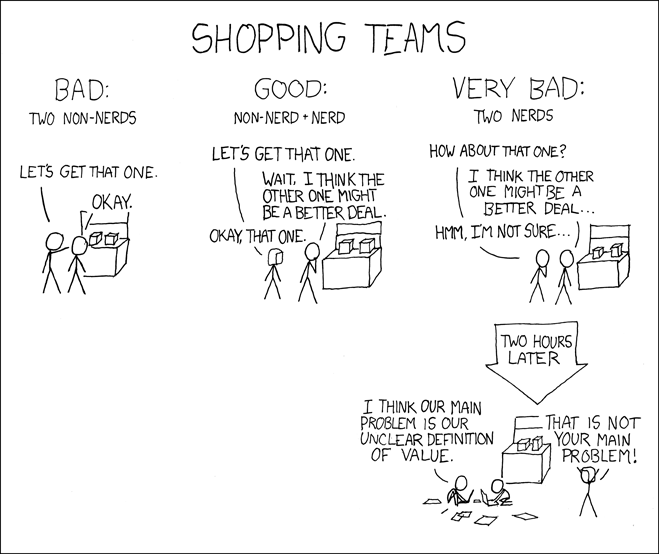
I'm looking forward to see how the other projects go. In the meantime, do not be fooled into extending the XP philosophy into your shopping patterns (from xkcd.com):
Btw, did you realize that a third of the course is already complete!

No comments:
Post a Comment