So begins the 2nd part of the course (I've logically divided it into 3 parts based on the Tests). First piece of advice - don't miss a single class! Due to personal reasons, I missed the class on Monday - when the 3rd project was being described - it's basically to implement the functionality of a heap. I felt lost when I came to class the other day - partly because there's no specs listed on the project page and also because I didn't realize how dependent I was to little things mentioned in class which help during quizzes and the project implementation. But I think I've caught up and now the project is going along full-steam ahead! Pair programming is going well - and I think I'm lucky to have found a partner who's as obsessive about correct indentation, spacing and brace-styles as I am!
So I don't have much material to talk about, since the class I did attend was mostly spent in re-introducing the different versions of the sum function for different iterators. Readings have finally started - and the quiz brought up the point of IS-A (inheritance) vs HAS-A (containment). For now, it's back to the project - we're knee-deep in pointer territory and you never know when a stray pointer could attack (the dereferenced ones are particularly vicious)!
Saturday, February 25, 2012

Saturday, February 18, 2012
#4 Feb 19
The week of the test...<Hitchcock scream + thunder and lightning>. Well, not so much - it was a pretty simple test if you've been following the material in class - and the best part was that most of it was a multiple-choice format which meant that we got the results in a day. I've always found the aftermath of a test to be more stressful than the test or its preparation, so I was quite happy.
This week we mostly covered different data structures, container classes and the cost of performing operations on those structures. But before I talk about that, there was one point made about using references instead of pointers which I really liked:
A reference always needs an l-value, so if you have a function that takes an argument by reference, mistakenly doing something like f(0) will cause a compiler error, but if you were taking the argument by pointer, then it would compile - but now you're dealing with that dark evil which has haunted programmers for centuries - the NULL pointer!
Back to data structures - the summary of all that was taught can be found in Prof. Downing's schedule here. Some interesting things in the discussion -
Also, this week we turned in project 2 - the Australian voting problem. The problem itself was quite easy - the unit tests took a very long time, since the problem input was quite cumbersome. Also, we did it as a pair programming exercise. The experience was a mixed bag - it's always better to have another pair of eyes on the code you do, but managing time to have compatible schedules so that we could program together was more of a challenge than the problem itself. This led to us tackling the problem quite late, which is something I dislike since I prefer finishing off assignments as soon as I possibly can.
I'm looking forward to see how the other projects go. In the meantime, do not be fooled into extending the XP philosophy into your shopping patterns (from xkcd.com):

Btw, did you realize that a third of the course is already complete!
This week we mostly covered different data structures, container classes and the cost of performing operations on those structures. But before I talk about that, there was one point made about using references instead of pointers which I really liked:
A reference always needs an l-value, so if you have a function that takes an argument by reference, mistakenly doing something like f(0) will cause a compiler error, but if you were taking the argument by pointer, then it would compile - but now you're dealing with that dark evil which has haunted programmers for centuries - the NULL pointer!
Back to data structures - the summary of all that was taught can be found in Prof. Downing's schedule here. Some interesting things in the discussion -
- A Deque is a variation of ArrayList except that instead of being front-loaded, it is center-loaded. This means that the cost of insertion and removal becomes an amortized constant - way better than the O(n) it was for insertion into an ArrayList.
- Also, stacks and queues are backed up by sequential structures, but queues cannot be backed by vector since vector does not offer a push_front / pop_front functionality. (It's O(n) for front-access, but ~O(1) for back-access)
- Similarly, priority_queues cannot be backed by lists since they need to implement heaps which need indexing capability. Also, it can't be modified in place since it doesn't return an l-value.
Also, this week we turned in project 2 - the Australian voting problem. The problem itself was quite easy - the unit tests took a very long time, since the problem input was quite cumbersome. Also, we did it as a pair programming exercise. The experience was a mixed bag - it's always better to have another pair of eyes on the code you do, but managing time to have compatible schedules so that we could program together was more of a challenge than the problem itself. This led to us tackling the problem quite late, which is something I dislike since I prefer finishing off assignments as soon as I possibly can.
I'm looking forward to see how the other projects go. In the meantime, do not be fooled into extending the XP philosophy into your shopping patterns (from xkcd.com):
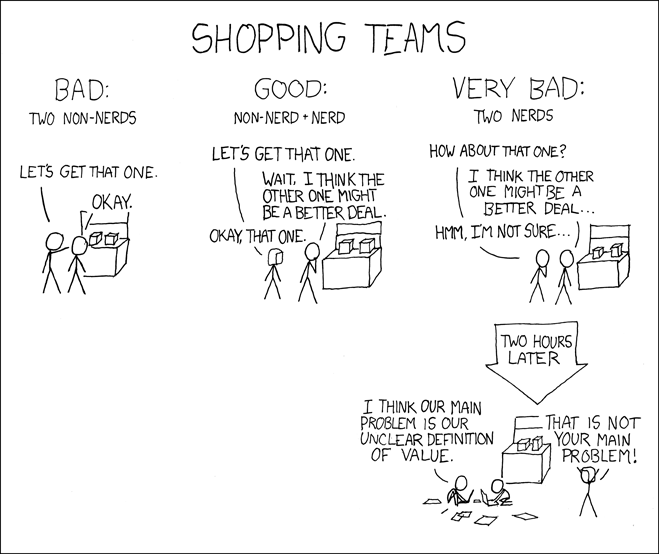
Btw, did you realize that a third of the course is already complete!
Sunday, February 12, 2012
#3 Feb 12
This week was mostly a continuation of the discussion of exceptions. Some of the things that I found interesting:
- C++ can throw any type whatsoever, it doesn't have to be an exception (soon you might see an int hurtling over your head!)
- If you are doing exception handling in C++, you should always throw by value and catch by reference. Catching it by value leads to 2 copies (ugly) and catching it by pointer means you have to throw a pointer and that can lead to all sorts of memory management hell.
- Stack allocation is faster than heap allocation, so avoid using the new operator if you can.
- Wondering what the differences between references and pointers are? Well one is that you can always declare a pointer variable uninitialized and it's OK to reassign them to different variables. References NEED to be initialized to some variable, and like swans - they mate for life.
- Finally in Java, (I know this but tend to ignore it while programming) use StringBuilder when repeatedly concatenating Strings, since doing something like str1 += str2 causes a new String to be built and assigned to str1 while its older value is garbage collected (they're immutable, remember)
We also started on the UVa Australian Voting problem. The logic seems pretty straightforward, once you're past the reading/ writing issues. More on that next week.
Saturday, February 4, 2012
#2 Feb 5
This week was submission week - and while Collatz V1 went as smoothly as a warm knife through butter, V2 nearly drove me insane with the obstinate "wrong answer" posted after 2 excruciating seconds of running the code. And I wasn't alone! This led tons of acceptance testing and then to a hailstorm of comments and discussions on Piazza - and finally it turned out that Sphere wasn't, in fact, expecting the right answer, rather one that had been masked to 32-bits even though the calculations clearly led to numbers beyond that range. Who would have known!! Anyway, Project 1 is done and dusted...and it's time to move on to Project 2, and with it, pair programming! More on that next week!
As far as class material goes, we've mostly been covering assertions and exceptions and also the l-value, r-value concepts related to operators. So far so good....more to come!
Subscribe to:
Posts (Atom)